Standard Operating Procedures (SOP)
The Los Santos Emergency Medical Services is a vital public safety and healthcare organisation committed to delivering high-quality emergency medical care across the city of Los Santos, the greater San Andreas region, and surrounding jurisdictions. With a jurisdictional area spanning 471 square miles (1,220 km²) and serving an estimated population of over 4 million residents, our mission is clear:
“To preserve life, promote recovery, and provide rapid, effective response to medical emergencies whenever and wherever they occur”
Our department operates 24 hours a day, 7 days a week, with highly trained Emergency Medical Technicians (EMTs), Paramedics, and Special Hospital Medical Units. Whether responding to traffic collisions, cardiac arrests, natural disasters, or mass-casualty incidents, we stand ready to deploy with speed, professionalism, and compassion.
We pride ourselves on maintaining a high standard of excellence, ensuring all personnel receive continuous education, field training, and certification in the latest lifesaving techniques and technologies. Each member of the EMS family shares a strong commitment to integrity, respect, and accountability values that define our interactions with patients, partners, and each other.
Beyond emergency response, EMS also plays a key role in public health and safety initiatives, collaborating with local law enforcement and government agencies to enhance community wellbeing and resilience.
As a member of the Los Santos Emergency Medical Services, you are not only a healthcare provider, you are a guardian of life, an ambassador of trust, and a pillar of the community. Your uniform represents more than just a role, it symbolises hope, care, and unwavering service.
We thank you for your commitment, and welcome you to a proud tradition of excellence in emergency medical care.
Code of Ethics for EMS
Professional status as an Emergency Medical Services (EMS) Practitioner is maintained and enriched by the willingness of the individual practitioner to accept and fulfil obligations to society, other medical professionals, and the EMS profession. As an EMS practitioner, I solemnly pledge myself to the following code of professional ethics:
- To conserve life, alleviate suffering, promote health, do no harm, and encourage the quality and equal availability of emergency medical care.
- To provide services based on human need, with compassion and respect for human dignity, unrestricted by consideration of nationality, race, creed, colour, or status; to not judge the merits of the patient’s request for service, nor allow the patient’s socioeconomic status to influence our demeanour or the care that we provide.
- To not use professional knowledge and skills in any enterprise detrimental to the public well being.
- To respect and hold in confidence all information of a confidential nature obtained in the course of professional service unless required by law to divulge such information.
- To use social media in a responsible and professional manner that does not discredit, dishonour, or embarrass an EMS organisation, co-workers, other health care practitioners, patients, individuals or the community at large.
- To maintain professional competence, striving always for clinical excellence in the delivery of patient care.
- To assume responsibility in upholding standards of professional practice and education.
- To assume responsibility for individual professional actions and judgement, both in dependent and independent emergency functions, and to know and uphold the laws which affect the practice of EMS.
- To be aware of and participate in matters of legislation and regulation affecting EMS.
- To work cooperatively with EMS associates and other allied healthcare professionals in the best interest of our patients.
- To refuse participation in unethical procedures, and assume the responsibility to expose incompetence or unethical conduct of others to the appropriate authority in a proper and professional manner.
Rank Structure
All members of EMS should respect the chain of command and employees are expected to address issues to supervisors and management. All employees are expected to be able to recognise superior rankings, address superiors by proper rank and title, and show respect for orders. Our Department is split into 3 groups;
- Management
- Supervisors
- EMS Staff
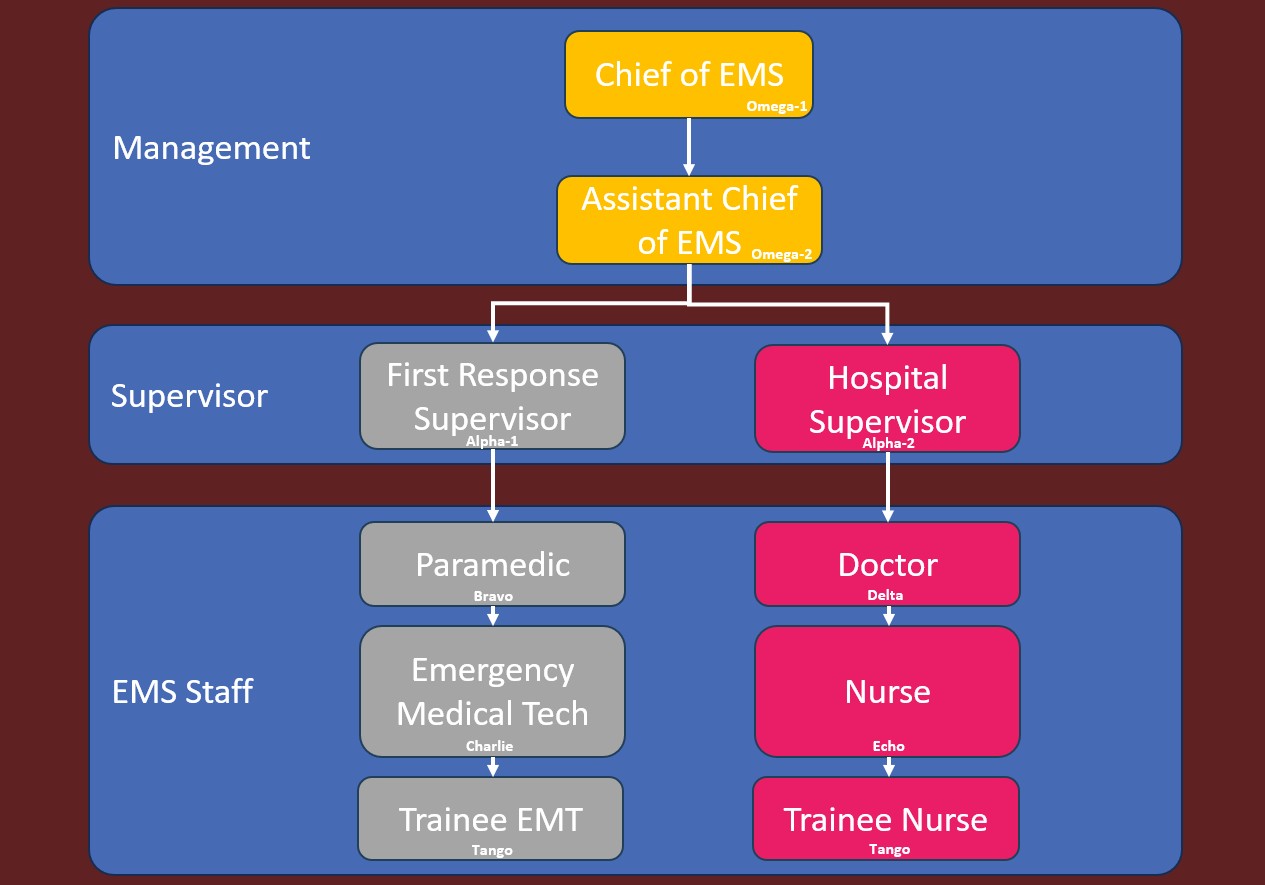
Management
Management is made up of 2 positions, who are responsible for the entire Department and its day-to-day operations as a whole. The positions are as follows;
- Chief of EMS
- Assistant Chief of EMS
Supervisors
The Supervisor group is reserved for the most experienced First Responders & Hospital Staff - who directly supervises EMTs, paramedics, nurses, and doctors. Acts as shift leader during operations.Responsible for real-time evaluations and mentoring.They will also handle logistics of ambulance dispatch or ER patient flow. The positions are as follows;
- First Response Supervisor
- Hospital Supervisor
EMS Staff
Hospital Staff’s main responsibilities will be receiving all Patients within the hospital - both ‘Walk In’ patients & patients being brought by First Responders. They will take immediate charge of the patient’s care while in the premises of the hospital. Taking them to X-Rays, Theatres etc - and overseeing their operations & care. The positions are as follows;
- Doctor
- Nurse
- Trainee Nurse
First Response’s primary responsibility will always be responding to URGENT calls for assistance either from members of the public or from other Government Agencies such as Police. The positions are as follows;
- Paramedic
- Emergency Medical Tech (EMT)
- Trainee EMT
EMS Training & Progression Summary
This EMS development model outlines a structured, tiered progression for emergency medical staff, divided into two primary career paths: the Hospital Track and the First Response Track. Each track consists of four progressive levels (G-1 to G-4), designed to build essential skills, deepen medical knowledge, and develop leadership capabilities.
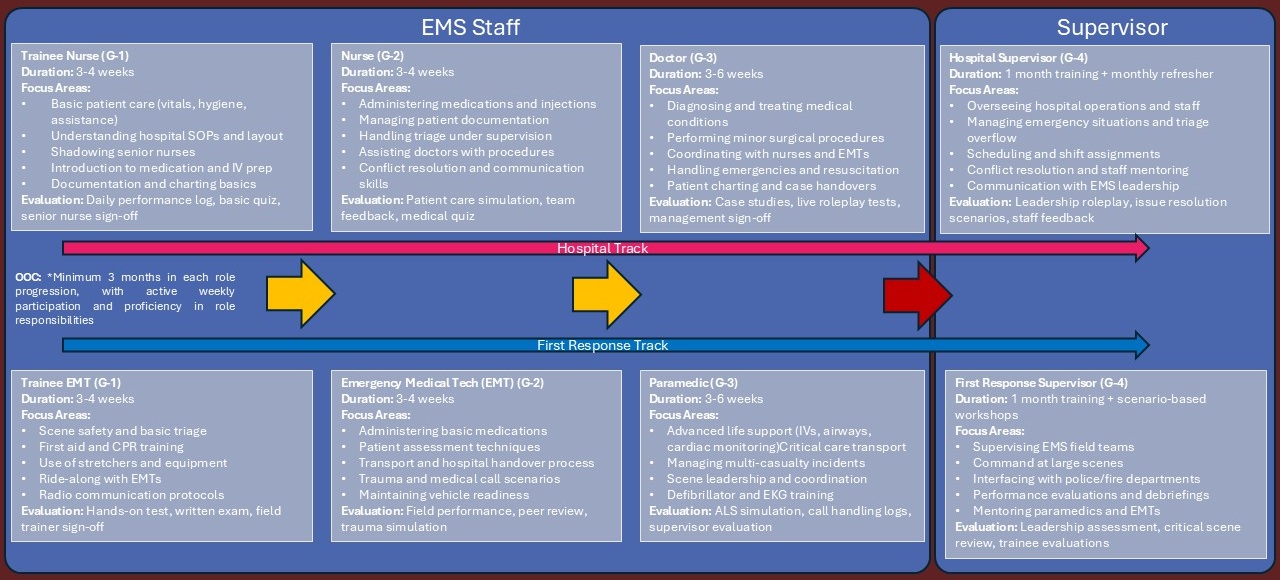
Hospital Track (G-1 to G-4)
This track prepares staff for in-hospital patient care and leadership in medical facility settings.
G-1: Trainee Nurse
- Entry-level training focused on basic patient care, hospital workflows, vital signs, hygiene, and basic documentation. Trainees shadow senior nurses and gain initial exposure to medications and IV preparation.
G-2: Nurse
- Nurses learn to administer medications, manage patient documentation, assist in triage, and support doctors in procedures. Training emphasizes communication, charting accuracy, and conflict resolution.
G-3: Doctor
- Doctors develop diagnostic and treatment skills, perform minor procedures, and coordinate closely with nurses and EMTs. They are trained in emergency response and case handovers within the hospital.
G-4: Hospital Supervisor
- Supervisors oversee hospital operations, manage staff schedules, resolve conflicts, and lead triage during high-pressure events. Leadership development, staff mentoring, and communication with EMS teams are key focuses.
First Response Track (G-1 to G-4)
This track equips EMS personnel to operate in the field, respond to emergencies, and take command at incident scenes.
G-1: Trainee EMT
- Trainees learn scene safety, basic triage, CPR, and first aid. They are introduced to EMT equipment, communication protocols, and gain field experience through supervised ride-alongs.
G-2: Emergency Medical Technician (EMT)
- EMTs build on foundational skills by learning to administer basic medications, assess patients in the field, and manage transport to hospitals. They handle real-world trauma and medical call scenarios.
G-3: Paramedic
- Paramedics receive advanced training in life support, airway management, cardiac monitoring, and critical care transport. They lead at complex scenes and manage multi-casualty incidents.
G-4: First Response Supervisor
- Supervisors coordinate EMS field teams, interface with police/fire services, lead debriefings, and mentor EMTs and paramedics. Training includes leadership simulations and evaluations of critical scenes.
Role Progression Criteria
Staff must spend a minimum of 3 months in each grade level, actively participating and demonstrating role proficiency through performance evaluations and practical assessments.